
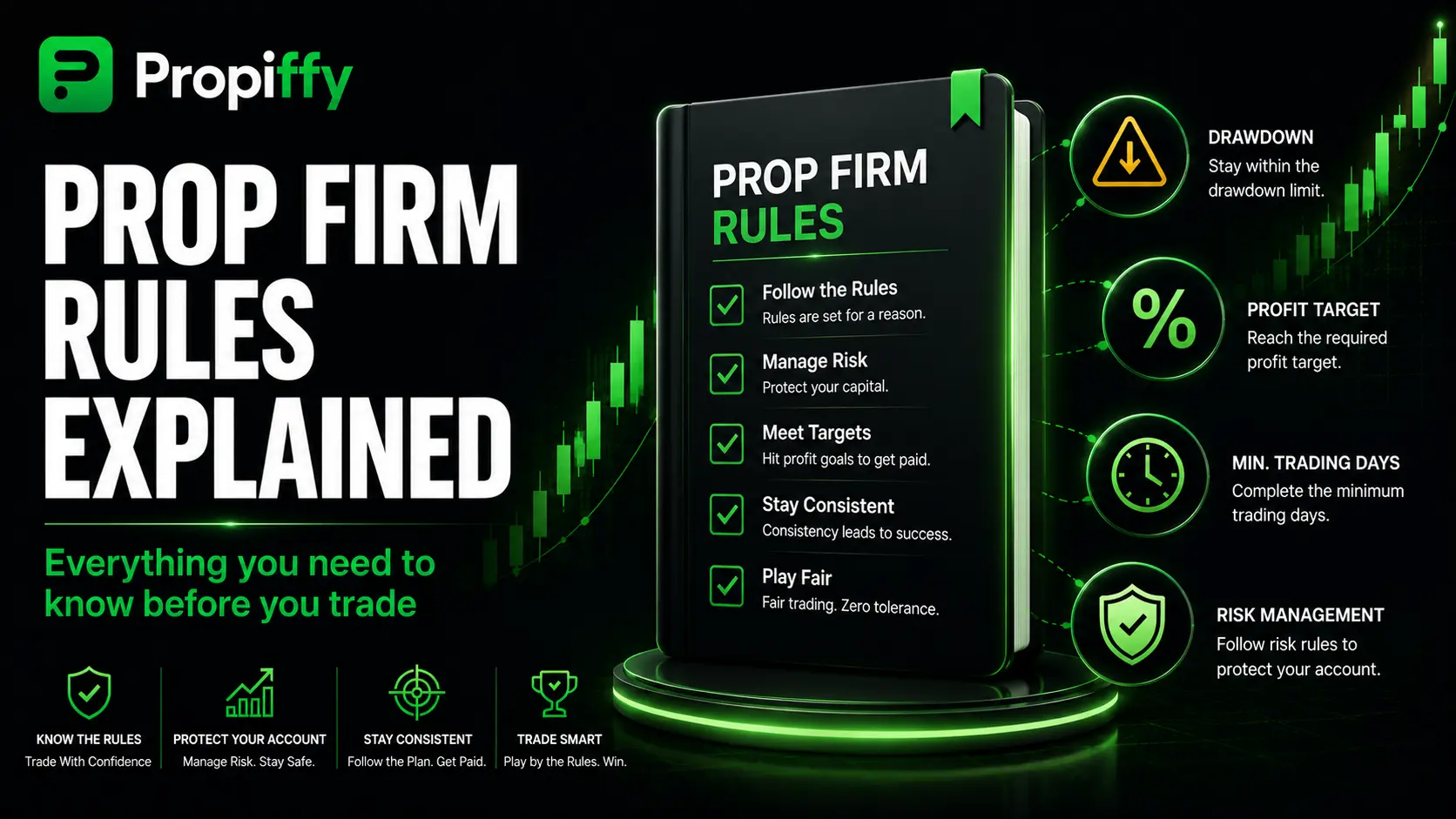
You've found a prop firm, you're ready to buy a challenge — but then you see a wall of rules: drawdown limits, consistency requirements, minimum trading days, news restrictions. It's overwhelming, and breaking even one of these rules can instantly end your account.
The good news? Once you understand what each rule actually means, they're not scary at all. This guide breaks down every major prop firm rule in plain English, so you know exactly what you're agreeing to before you spend a dollar.
Why Prop Firm Rules Exist
Prop firms give traders access to funded capital. To protect that capital, they set rules that force disciplined risk management. Think of the rules not as obstacles, but as a test: firms want to see if you can trade profitably without blowing up an account. Every rule is designed to measure exactly that.
1. Maximum Drawdown (Overall Loss Limit)
This is the total amount you're allowed to lose on your account. If your balance drops below this limit, the account is failed — permanently.
- Example: A $100,000 account with a 10% max drawdown means you cannot lose more than $10,000 total.
- Static vs. Trailing: A static drawdown stays fixed at the starting balance. A trailing drawdown moves up as your profits grow — which means it can lock in gains but also punish you if you give profits back.
👉 Trader tip: Always know whether your drawdown is static or trailing. Trailing drawdowns are much stricter and catch out many traders.
2. Daily Drawdown (Daily Loss Limit)
Separate from the overall limit, this caps how much you can lose in a single day.
- Example: A 5% daily drawdown on a $100,000 account means you can't lose more than $5,000 in one trading day.
- Most firms reset this limit at a set time (often 5 PM EST).
👉 Trader tip: If you're having a bad day, stop trading before you hit this limit. One disciplined "walk away" can save your entire account.
3. Profit Target
To pass the evaluation, you usually need to hit a profit target — a set percentage gain.
- 1-Step challenges: often a single 8–10% target.
- 2-Step challenges: typically 8% in Phase 1, then 5% in Phase 2.
- Instant funding: usually no target, but stricter ongoing rules.
4. Minimum Trading Days
Many firms require you to trade on a minimum number of days (commonly 3–5) before you can pass or request a payout. This stops traders from getting lucky on a single big trade.
👉 Trader tip: Don't rush. Spread your trades across the required days even if you hit the target early.
5. Consistency Rule
This is one of the most misunderstood rules. A consistency rule means no single day (or trade) can account for too much of your total profit — often capped at 20–30%.
- Example: If the cap is 30% and you make $3,000 total profit, no single day can contribute more than $900 of it.
- It exists to reward steady, repeatable trading over one lucky gamble.
6. News Trading Rules
Some firms restrict trading around high-impact news (like NFP, CPI, or interest rate announcements) — usually a few minutes before and after the event.
- Some firms ban it entirely; others only restrict it in the funded phase.
- Breaking this rule can void a payout or fail the account.
👉 Trader tip: Keep an economic calendar open so you never accidentally trade during a restricted window.
7. Weekend & Overnight Holding
Certain firms don't allow you to hold positions over the weekend (to avoid gap risk), and some restrict overnight holds. If you're a swing trader, check this rule carefully — it can make or break your strategy.
8. Expert Advisors (EAs) & Copy Trading
Automated trading is a grey area. Some firms allow EAs freely, others only permit non-arbitrage strategies, and some ban them completely. If you rely on automation, confirm the firm's policy before buying.
Quick Rules Checklist Before You Buy
Before purchasing any challenge, make sure you know the answers to these:
- ✅ What's the max drawdown — and is it static or trailing?
- ✅ What's the daily loss limit?
- ✅ What's the profit target?
- ✅ How many minimum trading days?
- ✅ Is there a consistency rule?
- ✅ Can I trade the news? Hold over weekends? Use EAs?
If you can answer all six, you're ready to trade with confidence.
The Smart Way to Compare Rules
Every prop firm publishes these rules differently, which makes comparing them a headache. On Propiffy, we lay out each firm's rules — drawdown, profit split, payout speed, news and weekend policies — side by side, all editor-verified, so you can compare firms in seconds instead of digging through fine print.
Browse all reviewed prop firms or use our prop firm finder to match your trading style to the right firm.
Frequently Asked Questions
What happens if I break a prop firm rule?
In most cases, breaking a hard rule (like max drawdown) instantly fails the account. Softer rules (like consistency) may only delay or reduce a payout. Always read your specific firm's terms.
Which prop firm rule fails the most traders?
The daily drawdown and trailing drawdown limits catch out the most traders — usually because they don't stop trading after a losing streak.
Do all prop firms have a consistency rule?
No. Consistency rules are common on instant-funding and some 1-step accounts, but many standard challenges don't have one. Check before you buy.
Can I trade news on a prop firm account?
It depends on the firm. Some allow it fully, some restrict it around high-impact events, and some ban it in the funded phase. Never assume — verify the rule first.
Final Thoughts
Prop firm rules aren't there to trap you — they're there to make you a disciplined trader. Once you understand max drawdown, daily limits, consistency, and news rules, you can pick a firm that fits your style and trade without fear of an accidental breach.
Do your homework, start small, and always read the rules in full before you commit. The traders who respect the rules are the ones who get funded — and stay funded.